
Smart Glasses and AI
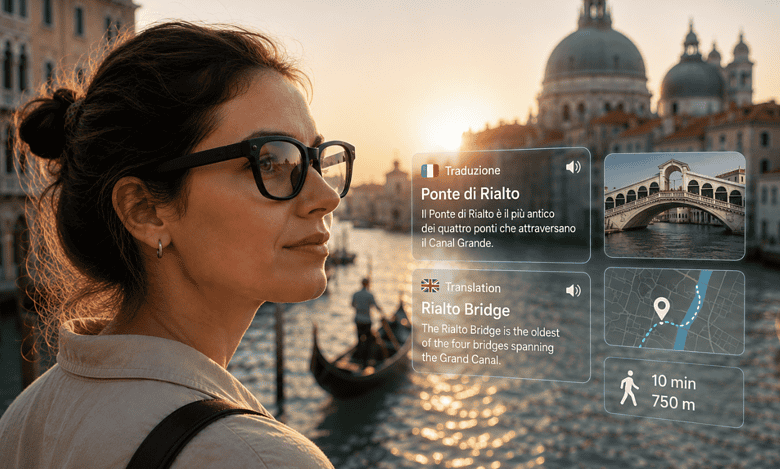
Tourism has long faced the challenge of language barriers. While infrastructure, transport, and digital services continue to improve, foreign languages remain an obstacle for many visitors. Translation apps on smartphones can help, but they often require users to repeatedly shift their attention away from their surroundings. This creates an opportunity for wearable technologies that operate discreetly in the background without requiring constant interaction.
The new generation of AI smart glasses is no longer designed solely for translation. By combining artificial intelligence, augmented reality, and voice control, these devices are gradually evolving into personal digital assistants that can support users while traveling, working, and managing everyday life.
Translation Glasses Return in a New Form
The idea of translation glasses is not new. In recent years, several devices have appeared on the market promising instant speech translation or subtitles displayed directly in front of the user’s eyes. However, the results often fell short of expectations. The glasses were heavy, slow, technologically immature, or too conspicuous for everyday wear.
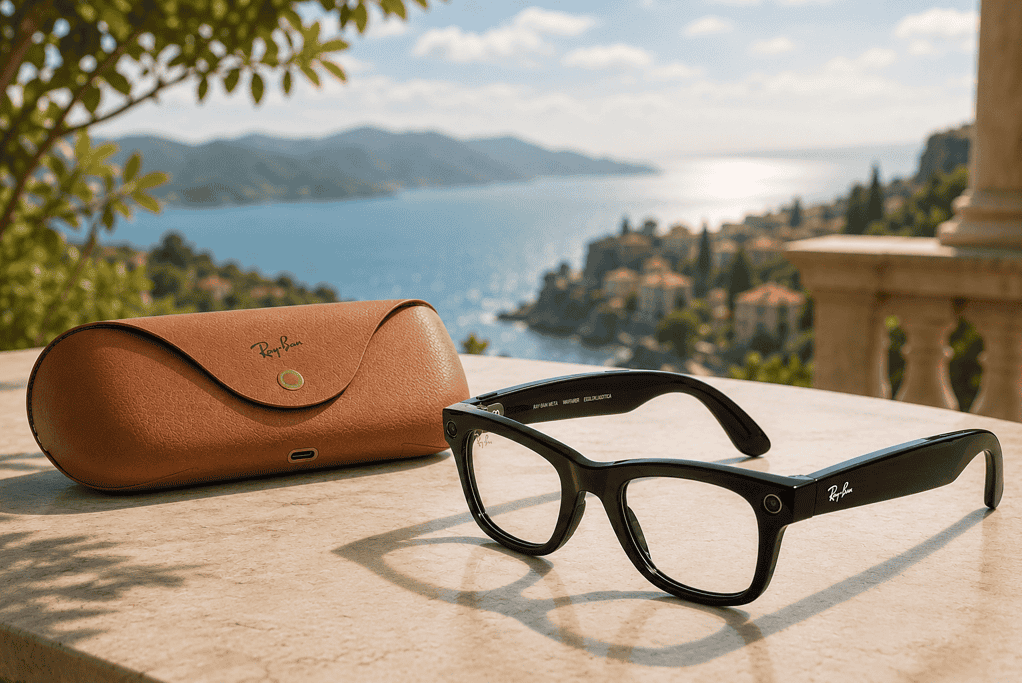
Today, the situation is changing significantly. A new generation of devices is entering the market, including well-known names such as Rokid and Ray-Ban Meta. Although individual models focus on different functions, they all share the same objective: to provide users with an AI assistant that is available at any time of day.
Foreign language translation is now just one of many available functions. Modern smart glasses can provide navigation, transcribe spoken language into text, work with artificial intelligence, display notifications, take photographs, record videos, and provide context-aware information.
Artificial Intelligence (AI) Working Alongside Augmented Reality (AR)
The biggest change compared with the previous generation is not the hardware itself, but the integration of artificial intelligence with augmented reality. Information appears directly in the user’s field of view at precisely the moment it is needed. Translations of ongoing conversations, navigation instructions, notifications, and short informational texts can be displayed without requiring the user to take a smartphone out of their pocket.
The appearance of the devices has also changed significantly. New models resemble ordinary prescription glasses or sunglasses and are designed for everyday wear. Many manufacturers offer customized prescription lenses, including those that correct astigmatism, so users do not need to wear their own prescription frames under the smart glasses. Some models also offer magnetic sun clips or interchangeable tinted filters. Their weight generally ranges from approximately 40 to 60 grams, making them comfortable to wear throughout the day.
In addition to translation and navigation, AI smart glasses can perform a range of everyday tasks. They allow users to make phone calls, take photographs, record videos, display notifications, and control the device using voice commands. Through their connection to AI models, they can answer questions, summarize information, help plan the day, find relevant information, and explain document content without requiring users to open their smartphones.
Live transcription is also becoming an important feature. The glasses can transcribe an ongoing conversation into text in real time, generate captions during business meetings, conferences, or lectures, and, in some models, simultaneously translate the content into a selected language. This makes them useful not only for travel but also for international business and education.

Traveling with an AI Assistant
Travel is one area where AI smart glasses can be particularly useful. Finding your way around an unfamiliar city, navigating on foot, translating menus, communicating with local residents, and obtaining information about landmarks can all happen naturally, without constantly shifting your attention between your surroundings and your smartphone screen.
Imagine walking through Venice. The glasses can discreetly guide you in the right direction, alert you to a turn in a narrow alley, translate a restaurant menu, or display brief information about a historic building you are passing. If you need to ask a question, the AI assistant can help translate the conversation almost in real time. You can remain engaged with your surroundings without having to search for information on your phone.
The technology does not replace the travel experience itself. On the contrary, it allows users to remain more connected with their surroundings while keeping the information they need readily available.
Applications Far Beyond Travel
The potential of AI smart glasses extends far beyond tourism. They can be used in international business meetings, education, logistics, industry, healthcare, and customer support.
By combining an AI assistant, augmented reality, and voice control, smart glasses are gradually becoming a new category of personal devices that can complement or partially replace smartphones in a variety of situations.
Current Limitations of AI Smart Glasses
Although the technology is developing rapidly, several limitations remain. Battery life is one of the most frequently mentioned concerns, ranging from a few hours to an entire day depending on how the glasses are used. Functions that rely on the camera, live translation, or continuous communication with AI consume power at a much faster rate.
Developers are also working to improve display quality in direct sunlight, speech recognition accuracy in noisy environments, and the availability of individual AI functions in different languages. Some advanced services also require a constant internet connection or a paid subscription.
The social acceptance of these devices presents another challenge. With models equipped with cameras, people nearby may have concerns about their privacy, similar to those raised when the first smart glasses appeared several years ago.

Market Availability
The category of AI smart glasses has expanded significantly over the past two years. Alongside devices focused primarily on translation, new models are emerging that are designed for AI assistance, multimedia, or professional use.
The best-known devices today include Ray-Ban Meta smart glasses, developed jointly by EssilorLuxottica and Meta, and Rokid smart glasses. EssilorLuxottica is also expanding its activities in the smart glasses sector. At its facility in Agordo, Veneto, the company is preparing to manufacture smart devices and is working with Applied Materials to develop optical technologies for a new generation of AR and AI glasses.
Prices for standard consumer models currently range from approximately €300 to €800, while professional solutions designed for industry or remote assistance can cost several thousand euros. However, prices are expected to gradually decline as competition increases and the range of available features continues to expand.
Data Privacy and Security
As with other AI-powered devices, protecting personal data is crucial. AI smart glasses can process voice commands, photographs, videos, and user location data. How this information is handled varies depending on the manufacturer and the AI services being used.
Most manufacturers allow users to choose which functions are active and to set permissions for the camera, microphone, and data storage. Enterprise solutions also tend to emphasize encrypted communication, device management, and operation within a secure corporate environment.
Before using AI smart glasses, users should review the manufacturer’s data-processing terms and consider what information is shared with cloud-based AI services.
The Future of AI Assistants
After years of unsuccessful attempts, AI smart glasses are finally reaching a stage where they no longer feel like a technology demonstration but a practical tool for everyday use. Foreign language translation was only the first step. The real future of these devices lies in their role as personal AI assistants that can help with orientation, communication, navigation, speech transcription, information retrieval, and the organization of everyday activities.
In the coming years, artificial intelligence will determine how useful smart glasses become. Their development is no longer solely about the hardware but, above all, about the software, AI services, and integration with the user’s digital ecosystem. Users will have an assistant available directly in their field of view, ready to offer advice, translate, provide directions, or answer a question within seconds.
We may therefore be at the beginning of an era in which AI smart glasses cease to be a technological novelty and become personal devices as common as smartphones are today.
Discover more articles about new technologies, digital innovation, and their practical applications on Veneto Technologies, including our article “Web3 Explained Simply: How the Technology Works.”